
Expanding Outward, Collapsing Inward — The Zionist Project Is Israel’s Undoing
And that’s a good thing

(If you have received this by email, please click on the title to read the latest version. I often correct typos and continue to edit my essays after publishing the first version).

I don’t like writing about Israel because I don’t want to feed its society’s insatiable need for constant attention, and because it’s vile. But I do write about it because I want to support activism for Palestinian human rights. I would like to help bring about a moment when the world finally finds its moral backbone and starts acting decisively to back the Palestinian people and end Israel’s settler colonial project. To achieve this, people must lose their confusion, insecurity, and the fear that they are in the wrong. I write about the crime and the criminal because to deal with a problem properly we need to understand its causes. Our focus needs to be this 100-year-old crime conceived at the tail end of a dark colonialist era, and committed before our eyes with the collusion of our own governments.
In 2025, according to Israel’s Central Bureau of Statistics — which makes this data available only in Hebrew and avoids drawing attention to negative migration — 69,000 Israelis left the country. Only 19,000 returned. For the first time in Israel’s history, the international migration balance turned negative. Since the current government took office, more than 200,000 Israelis have emigrated. Yair Lapid, the opposition leader, described it in January as an unprecedented wave of negative migration. Israel’s financial newspaper Calcalist put it more bluntly, arguing that ‘the first priority of the next government must be to stop the severe bleeding of negative migration from Israel.’
“Since 7 October, it is estimated that more than half a million members of the State of Israel, as I call them, have emigrated”. — Ilan Pappé. Israel on the Brink. p. 31.
Those leaving are disproportionately the young, the educated, the secular, the economically productive. They occupy the heart of Israel’s military, commerce, finance, and high-tech sectors. Their decision to leave isn’t necessarily motivated by sudden love or concern for the Palestinians. They’re looking round them and into the future, and they’re tired of living in a state of perpetual war. They don’t want to sacrifice their children’s futures, lives and wellbeing for the doomed and evil cause of an exclusively Jewish state.
At the same time as Israeli Jews are leaving, Israel is quietly importing foreign labour at record speed. The number of foreign workers has surged by nearly 80 per cent from 109,200 in 2023 to 195,700 today, with a government quota set at 336,000 — over 3 per cent of Israel’s entire population. This was driven largely by the exclusion of Palestinian workers after October 2023. Roughly 156,000 Palestinians worked in Israel before the war, but only 34,000 had returned to Israeli employers by the end of 2025. The policy was introduced with no comprehensive planning and no public debate. The Calcalist report says that the “expanded framework is expected to allow foreign workers into a long list of industries that had not previously experienced labor shortages.”
Permission to Rape
The man who is currently the IDF’s Chief Military Rabbi, Eyal Karim, issued religious rulings permitting soldiers to rape non-Jewish women during wartime ‘out of consideration for the difficulties faced by soldiers.’ “It is permitted to breach the walls of modesty and satisfy the evil inclination by lying with attractive gentile (non-Jewish) women against their will, out of consideration for the difficulties faced by the soldiers and for overall success,” the newly-appointed Israeli military Rabbi said in a 2002. The ruling resurfaced and caused controversy when he was appointed in 2016. (He has apparently changed his tune since).
Another senior rabbi, Shmuel Eliyahu chief rabbi of Safed, son of a former Chief Rabbi of Israel (Mordechai Eliyahu), and a contender for the Chief Rabbi role himself, has argued soldiers would lose their will to fight if denied the same ‘right.’ Electronic Intifada reports that this has ‘largely gone unnoticed’.
These are not fringe voices. These are the kind of men who occupy the most senior religious positions in the state and its military and who ultimately seek to rule the country by Jewish religious law. Those who are leaving don’t want to live in a society run by Medieval religious law, under the control of repugnant, psychopathic rabbis who condone rape and who treat ‘non-Jewish women’ as objects whose purpose is to satisfy the ‘needs’ of Israeli soldiers. The fact that there has been no international backlash against Israel — I haven’t seen any — and not even from feminist organisations, testifies to the world’s complicity and double standard.
The country’s educated classes tend to have Western sensibilities (except with regard to Palestinians). They can read the room, and they’re voting with their feet. Those who allow their children to grow up and serve Israel’s society and its military, condemn them to a life of psychological and moral ruin.
When I left in 1991 I was the same as those who are leaving now. I wasn’t politically enlightened. I may have been ‘lefty’, but I was still a product of Israel’s insidious indoctrination. I was ten years away from renouncing my Israeli citizenship and becoming an anti-Zionist — from seeing history more clearly, grasping the settler-colonial reality and Israel’s end goal for the Palestinian people.
I left because two years into studying politics at university, it became clear to me that all I could expect was a life by the sword forever. I wanted a chance at a full life, not a life ruled by aggression, suspicion and paranoia. As a woman, I didn’t like the tightening stranglehold Jewish religion was having on society. I didn’t like how women were treated, and I wasn’t going to sit and wait while the religious mob took over and started dictating to me what I could wear, or eat, where I was allowed to go, telling me that I should sit at the back of the bus so men could have the front, and that I should obey my husband.
As the eighties drew to a close, I lived in fear that my rights as a woman would be taken away any day. I was thirty-five years too early, but I was right. Everything I believed was going to happen, even without understanding the settler colonial reality, is happening, including Israel’s fanatical escalation of its plan to remove every last Palestinian from all of historic Palestine by any means necessary.
The Israeli government’s response to the growing wave of Jewish migration out of the country is to launch ever-more-aggressive campaigns to recruit Jews from abroad. The latest programme is called ‘Aliyat HaTekuma — ‘Aliyah of Renewal’, or something more like ‘immigration for rebuilding’. It targets France, Britain, Canada and Australia with grants, housing subsidies, fast-tracked bureaucracy, and now a five-year income-tax exemption for anyone who immigrates in 2026. The government has set a target of 30,000 new Jewish immigrants this year. Finance Minister Smotrich, who has been leading the settlement expansion campaign in the West Bank, announced: “The year 2026 will bring a revolution in Aliyah1 — not as a slogan, but as a practical plan of action. I call upon Jews in the Diaspora and Israelis abroad: come home.”
“Given the colossal expenditure needed to sustain a war with Gaza and, as of 2024, effectively with Lebanon, even the generous US financial aid does not suffice to plug the deficit. Multinational companies want to invest in safe bets and Israel is rapidly ceasing to be one. Faced with the potential emigration of wealthy elites on the one hand, and a resource-draining war on the other, anything could tip the Israeli economy over the edge and into a freefall, such as a shift in US policy.” — Ilan Pappé. Israel on the Brink. p.41
Civilian Society Shrinking, Military Society Expanding
While the civilian population is shrinking, the military is expanding and these two factors are interconnected. Israel’s public television channel Kan 11, has recently broadcasted a feature on a new infantry pilot programme called ‘Jaguar’. Jaguar is an all-women battalion (gdud) created in the wake of October 7, tasked with border protection. The report celebrated it as a testament to Israeli equality and national resilience. The soldiers’ faces were blurred or covered throughout. The blurring of faces is not modesty. Since an Israeli soldier vacationing in Brazil fled the country in 2025 to avoid prosecution under universal jurisdiction for alleged Gaza war crimes, the Israeli military has required soldiers’ faces to be obscured in media coverage and is warning soldiers against social media posts about their service.

The Kan 11 report was meant as a proud morale lifting weekend piece, designed to celebrate and inspire an increasingly stressed and dispirited population. In the UK and US women have been embedded within the military in combat roles for decades. But in Israel this is new. Women have traditionally fulfilled support and training roles in Israel’s military, but have never participated directly in combat. Jaguar is still at the pilot stage. Other units are also experimenting with having women in combat roles. This report from Ynet tells the story of five combat female soldiers, all religious. Three of the women immigrated from the US specifically to join the Israeli army — this suggests that desperate Israel is sending emissaries to Jewish communities in the US specifically to recruit soldiers. The three women are from New York, Los Angeles and New Jersey and they discuss what it’s like to be religious and a female combat soldier.
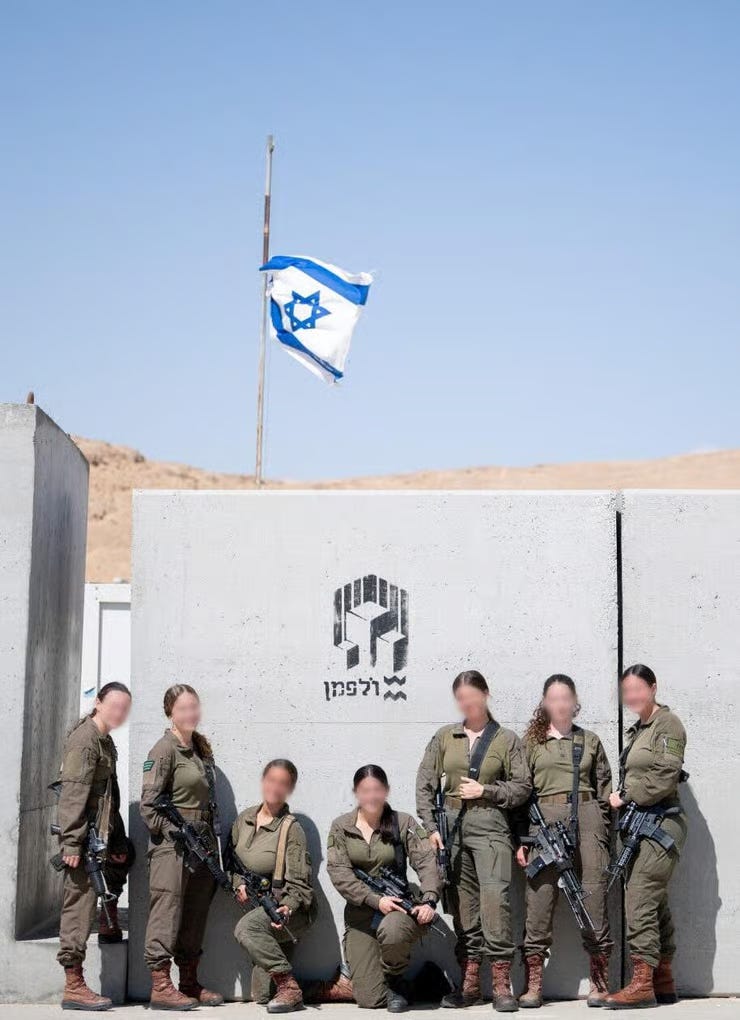
These are not eighteen or twenty-year-old conscripts. Some have been recruited directly from civilian life. Women in their twenties and thirties, presumably with jobs, careers, lives — brought into military service at a moment when Israel is simultaneously attacking in Gaza, Lebanon, and Iran and tightening its grip on the colonised West Bank. The US can replenish Israel’s weapons indefinitely. But it cannot give Israel people. These stories are evidence of a militarised society that has expanded its military apparatus beyond its capacity and is desperate.
There is a pretence of equality in these stories — a feminist angle — alongside naked nationalism and settler colonial zeal. Anyone tempted to see this as an example of how ‘progressive’ Israel is, needs to recognise that this ‘progress’ rests on extremely thin ice. The same rabbinical establishment now praised for embracing Jaguar and other women’s combat units, has spent years declaring female military service ‘entirely forbidden’ under Jewish law. Eyal Karim — the IDF’s current Chief Military Rabbi who ruled that raping non-Jewish women during wartime is permissible — has separately argued that women’s enlistment damages ‘the modesty of the girl and the nation’.
In 2026, a coalition of senior rabbis went further still, warning that a Supreme Court ruling requiring equal combat opportunities for women ‘endangers soldiers’ lives’ and ‘damages Israel’s social cohesion’. They instructed that judicial rulings contradicting religious authority should not be obeyed. Rabbi Yigal Levenstein, head of a pre-military academy, said in 2017 that religious women who serve in the military become ‘crazy’ and lose their religious values and Jewishness.
This is not a society quietly progressing toward equality. Recruiting women into combat roles is a wartime stopgap, tolerated for now because Israel cannot fill its ranks without women. Just as women were sent back to the kitchen once their labour during the First World War was no longer needed, and women’s football was banned by the FA in 1921, the female soldiers currently celebrated as ‘warriors’ in masked and blurred-faces are being used, not liberated. Nothing in Israel’s religious establishment suggests this will last. Ilan Pappé has been warning that Israel is rapidly becoming a religious state that he calls the ‘State of Judea.’ Once those rabbis are firmly in charge, any progress Israel has made for its Jewish population will be undone.
The cost of this militarisation is now visible in the most mundane corners of Israeli civilian life. Roughly seventy-two US Air Force refuelling tankers now occupy Ben Gurion Airport’s tarmac, with dozens more at Ramon Airport near Eilat, leaving the country’s only major international gateway to operate at about a third of its capacity. Israel’s own Civil Aviation Authority chief warned that ‘the defence establishment lacks sufficient understanding of the severity of the damage to civil aviation’, and that turning Ben Gurion into a military base ‘harms not only the airlines, but all citizens of the country’.
Transport Minister Miri Regev wrote directly to Netanyahu warning that up to 2.4 million flight tickets for the summer and holiday season could be cancelled, telling him that ‘mass flight cancellations for summer vacations and holidays at a time when the Israeli public needs calm and normalcy more than ever will damage national morale and civic resilience’ — and that the responsibility ‘will be rightly attributed to the government’s inability to provide a solution to a solvable problem’. Hundreds of Israeli families have already had hotel reservations in Eilat cancelled outright to make room for American troops. This is what militarisation in the service of an unsustainable settler-colonial project looks like.
Jewish Israeli society is now so thoroughly subordinated to its own war machine that it can no longer move as freely within or beyond its own borders as it used to. This is another symptom of a settler-colonial project crumbling under its own internal contradictions. That a government minister felt the need to complain about it is not just bizarre — it reveals something close to the heart of why so many Israelis are leaving. Israel was always a contradiction in terms. It wants to be a heavily and permanently militarised settler-colonial state punching above its weight that would, somehow, also deliver a comfortable, secular, Western capitalist life — foreign holidays, mobility, prosperity. The contradiction is now becoming visible in the most literal way possible. The war machine and the holiday flight are now competing for the same parking space at Ben Gurion airport, and the war machine is winning.
The Man From Bat Yam
A few days ago Kan 11 reported that Israeli police arrested a man in his thirties from Bat Yam and charged him with performing security-related tasks for Iran. He was apparently recruited via social media, for money. Bat Yam is where I grew up. It’s a Jewish-Israeli city south of Tel Aviv, heavily working class, historically nationalist, the kind of place that votes Likud and hangs flags on independence day. He did this for money, not ideology.
In the Israel I grew up in, this would have been almost unthinkable — not because Israelis were uniquely patriotic in some abstract sense, but because the social contract held. Military service was a shared burden. The economy, though never easy, functioned. The siege mentality, for all its psychological damage, produced a genuine sense of collective purpose. You sacrificed because everyone sacrificed, and the state delivered something in return: community, a sense of belonging to something larger than yourself but most importantly, a safe haven from a world that ‘hates Jews and wants to annihilate them’.
Mordechai Vanunu was made into a horrifying example of what happened to those who betrayed the state and this worked for a long time. But something is changing. A man from Bat Yam has calculated that Iranian money matters more than national loyalty. The hundreds of billions flowing into military expenditure, weapons replenishment, the wars in Iran and Lebanon, the settlement project in the West Bank — none of it is improving his life. He is being asked to sacrifice for a project that increasingly serves settlers, arms manufacturers, and a political class that has hollowed out Israeli civil society in pursuit of profit and territorial expansion, while ordinary Israelis in Bat Yam count the cost.
This case may be anecdotal. But anecdotes are still data, and this one points toward something structural: the social contract that made the Israeli state function for its Jewish citizens is fraying at the base.
In a recent interview with Chris Hedges, Alistair Crook said:
“The buffer zone didn’t work 20 years ago, and it’s certainly not working now. And instead of which, they’re suffering heavy casualties as they are still in South Lebanon, still destroying towns, clearing towns. They are suffering heavy casualties from Hezbollah, which are using new drones with a cyber [sic] optic connection, which are exhausting large casualties. There’s no figures for the casualties, but I estimate roughly about 8 to 10 casualties on the Israeli side per day. …
But the most important thing is that the [Israeli] army is disintegrating. The head of the chief of staff went to the cabinet and said, “I want to put up 10 red lights to you. The IDF is in the point of implosion. It just won’t go on. It cannot go on. We are fighting these forever wars across the Middle East, and we haven’t the people, and we haven’t the resources. And the army is also falling apart because of poor discipline and a lack of morality.” …
The other thing that I think is clear is the growing crisis inside Israel. And the questioning because when … senior defense and security officials in Israel are saying, “Israel is in a trap. We are getting involved in these forever wars. We’re getting bogged down in Lebanon, Gaza and Syria and we’d like to get bogged down in Iran. And we don’t have the means to get out of it. We are in a trap of our own making. …
And these people are beginning to say … “Maybe we have to have a root and branch consideration of what is Zionism and what we mean by that today. We cannot just go on simply expanding and increasing and taking territory by force, which then we’re obliged to hold by force and hold by force of arms of our military. We can’t just go on in this. We are overextended.” The Chief of Defense staff told the cabinet, reportedly in the Hebrew press, that to do what we’re doing now would take us to have six or seven IDFs besides the one we already have. We’d need that many more men to make our present commitments even feasible.
Israel’s settler colonial project is failing
History offers a template for what comes next, though the details will obviously be specific to this time and place.
The British Empire did not end because it was militarily defeated. It ended because the project became unsustainable — the human cost to British society of maintaining it, the economic reality, the impossibility of continuing to suppress the justified demands of colonised peoples indefinitely. The end came faster than almost anyone predicted, and it came from multiple directions simultaneously. India in 1947 shocked people who had assumed British rule would continue for generations.
The Zionist project is facing something similar. Not one fatal blow, but a simultaneous unravelling: the demographic reality that no amount of aliyah recruitment can reverse, the international isolation deepening as the violence becomes impossible to hide, or justify even to Israel’s most loyal enablers, the economic and social consequences of permanent militarisation, and the internal social contract shredding as those with options leave and those without options grow increasingly unwilling to die for a project that does not serve them.
The Zionist promise was always: come here, sacrifice, and it will be worth it. You will be safe. You’ll feel at home, and the Jewish state will stand between you and the next holocaust.
One of the reasons Israeli Jews have always been so fanatical about their country is the paradoxical sense of impermanence. Deep down every Israeli Jew fears that this experiment in creating a Jewish ghetto in the Middle East wouldn’t last. The data increasingly validate this intuitive fear. And Israel continues to bomb, to displace, to demolish, to settle — racing against a clock it cannot stop, to complete a project that the world is finally, slowly, refusing to pretend is something other than what it is.
Settler-colonialism has succeeded in Australia, Canada, the United States, but only because the indigenous population was all but annihilated. Thankfully, Israel has not achieved this. Despite seventy-eight years of incremental genocide — Gaza and the West Bank are an escalation of the same process, not something new — the Palestinian people have not disappeared, and Israel is now attempting, with increasing desperation, to finish what those other settler-colonial projects completed long ago. Despite its claims to ‘specialness’ Israel is not an exception in history. It is the last act of a chapter of history that should be ending.
The violence will continue. It will probably get worse before it gets better. Ilan Pappé is probably right that the worst excesses come at the end, and the end may not be as far away as the bombs would have you believe. But as we continue to put pressure on a crumbling edifice, we need to remember that the Palestinians are on borrowed time. Israel is collapsing, but my worry is how many Palestinians, and others it will attempt to take with it.
The Hebrew word for Israelis who emigrate is yordim — ‘those who go down or descend’. It was coined in opposition to olim, ‘those who ascend’ — those who come to Israel — who make ‘aliyah’. The contempt embedded in the term tells you everything about how the Zionist movement historically viewed departure as a kind of moral failure, a betrayal of the collective project. Those who are leaving now have decided they can live with that contempt.
A comment on paid subscriptions
Substack encourages writers to activate paid subscriptions. They take a small cut to enable them to provide this, otherwise free-to-use platform. I am grateful to the readers who have pledged money for monthly or yearly subscriptions, but I have no intention of monetising my work.
I do not want to turn my writing into an obligation, but even more importantly, I don’t believe in a tiered system where those who can pay get preferential treatment over those who can’t, such as the right to comment, or privileged content. This hierarchy of ‘worthiness’, especially based on such an arbitrary principle like how much money people have, couldn’t be further away from my values.
If you do feel moved to make a contribution to support my writing, see the ‘buy me a coffee’ button below. If you haven’t seen it before, it is a way of offering a donation to freelance writers. Payments are processed securely by Stripe on the ‘Buy Me A Coffee’ site. I believe people can keep donations anonymous if they wish. This is entirely voluntary. Everyone is and always will be welcome to read my work free of charge.
Thank you so much for reading my work!
A quote from a recent article by Ilan Pappe:
“But even in this dark moment we should understand that settler colonial projects that disintegrate are always using the worst kind of means to try and save their project….I am not saying this as a wishful thinking, and I am not saying this as a political activist; I am saying this as a scholar of Israel and Palestine with all the confidence of my scholarly qualifications. On the basis of sober professional examination, I am stating that we are witnessing the end of the Zionist project; there’s no doubt about it.
This historical project has come to an end, and it is a violent end – such projects usually collapse violently, and thus, it is a very dangerous moment for the victims of this project, and the victims are always the Palestinians, along with Jews, because Jews are also victims of the Zionism. Thus, the process of collapse is not just a moment of hope, it is also the dawn that will break after the darkness, and it is the light at the end of the tunnel.”
You cannot sustain this level of full spectrum state violence indefinitely without eventually collapsing in some way. Even the vast economic and military spending by the US and, more importantly, their actions in propping up the Israeli economy, cannot save them. They truly are Pariahs and it’s ever decreasing circles for these ghastly butchers