
People’s Inner ‘War' With Themselves
Sharing a resource from my practice

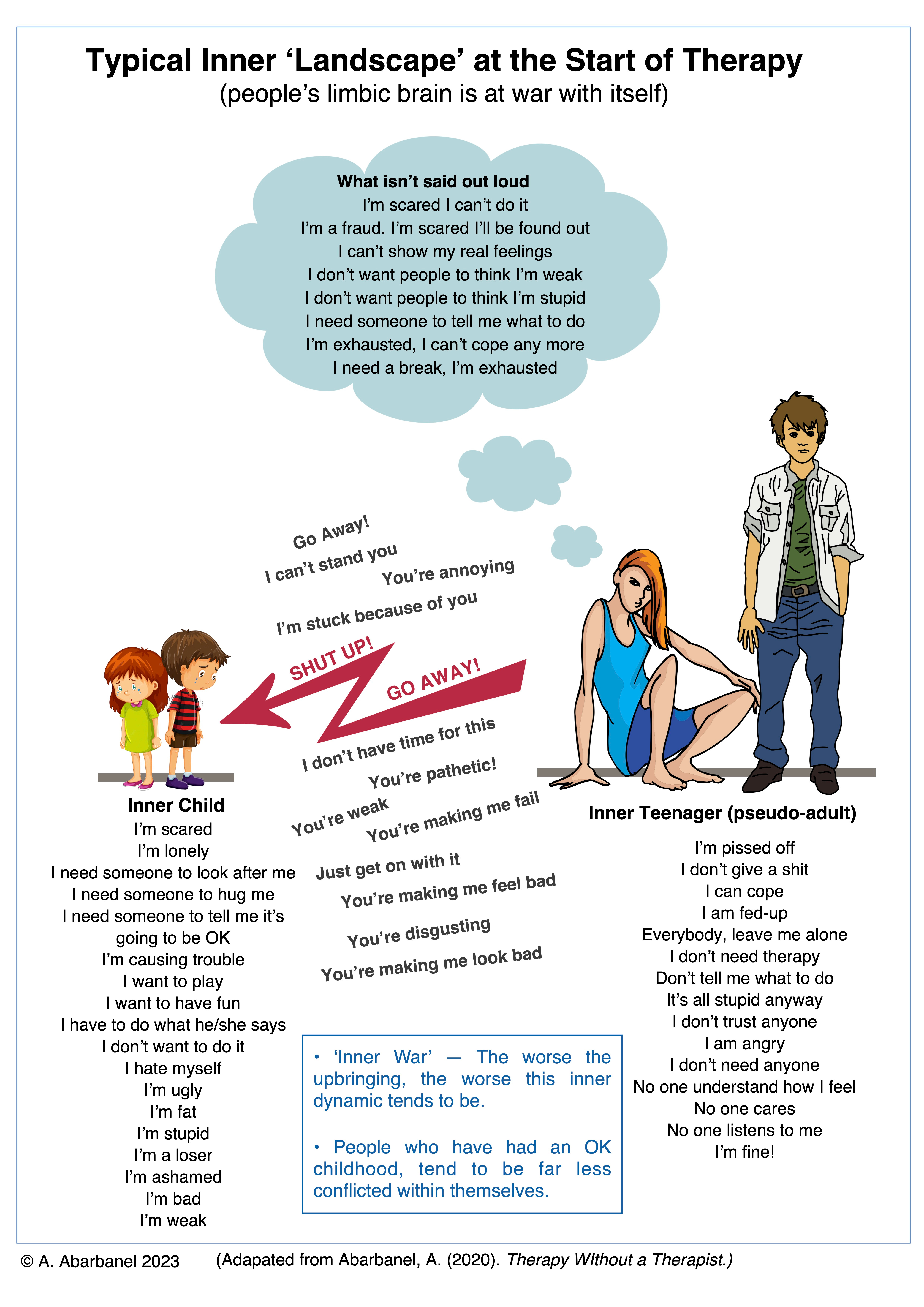
I have updated the image from page 111 of my book, Therapy Without A Therapist to create a poster for my office’s walls. I thought I’d share it here too in the hope that some people would find it validating and useful. Feel free to download, or print and share.
When most people come to therapy, they are in a state of war with themselves. Their limbic brain is fighting itself. This is always the result of not feeling validated in childhood and adolescence, and/or having been mistreated by the adult world around us.
Most people grow up with parents who are not integrated enough. They parent their children out of their limbic brains, most commonly out of their teenager self.
Parents who are very immature and chaotic, try to parent their children out of an even younger version of themselves. This almost always leads to trauma. I have always thought that my mother and father’s psychological age was no more than about 5 y/o. They were terrifying to grow up with.
By the time children turn into teenagers, they stop trusting the adults around them. They can easily sense that emotionally, the so-called adults are not much older than they are. Of course they don’t trust their instincts, and even if they did, there is usually little or no help for this from the outside. When teenagers shout at their parents, ‘grow up’, they do so for a good reason. But this usually does not lead anywhere.
I don’t blame parents. All humans — and I do mean everyone — do the best they can with the level of development they have achieved, at any given time. Some people’s best can be truly awful, even dangerous.
We just have to be honest enough to acknowledge that this is how it is, instead of blaming children and young people for the problems they have, or making them feel like they are psychologically unwell. Children and young people are a reflection of their environment. The brains of the adults around them are the blueprints for their brains, the guide for their brains’ development.
If the parents are continually growing and integrating, children and teenagers will be just fine because they will have a blueprint for growth. It’s not perfection that children and young people need. They need the adults’ commitment to their own ongoing integration and growth. It’s the unintegrated parts of parents’ brains that are most likely to leave a difficult legacy in children’s brains. So this should be sufficient motivation for all parents, or anyone who deals with children and young people, to engage with their own integration and growth actively. As an adult it is the most loving thing you can do for yourself, and for the children and young people in your life.
The most advanced part of the limbic brain, the teenager version of us (aka the ‘pseudo adult’) tends to be in charge in most functional people’s lives. Until we integrate enough, and place the true adult in the brain, our prefrontal cortex, in charge of our lives, we are bound to feel angry, lost, scared (aka anxious), conflicted with ourselves, out of our depth, overwhelmed, ashamed, exhausted, stressed, etc.
It doesn’t matter how objectively qualified, educated, intelligent, knowledgable, high up in their job, or capable a person is, they will not feel up to managing their adult responsibilities in our complex world, if their limbic brain is in charge.
You do not have to have suffered abuse or neglect to be conflicted with yourself, or feel anxious, stressed, or overwhelmed. Perhaps your teenager self is in charge of your life, and you need to start integrating...