
Growing Through Crisis
Why Human Development Is the Most Urgent Project of Our Time

(If you have received this by email, please click on the title to read the latest version. I often correct typos and continue to edit my essays after publishing the first version).

The US-Israeli attack on Iran was launched during active negotiations. It murdered Khamenei and other Iranian officials at a moment when Oman’s foreign minister had just announced a breakthrough — Iran had agreed never to stockpile enriched uranium and to full IAEA verification. Peace was described as ‘within reach’. Talks were expected to resume on 2nd of March but the attack came instead.
Now on day 35, the US and Israel have expanded strikes to hit the Pasteur Institute — a century-old medical research centre — steel plants, bridges, and a Red Crescent aid warehouse. At least 2,076 people have been intentionally killed and 26,500 wounded in Iran, and more than 600 schools and education centres have been hit.
Meanwhile Israel continues to pound and starve Gaza, ethnically cleanse the West Bank and the south of Lebanon. And Israeli society, as I have written in a recent essay, remains locked in a stupefying cult trance: elderly comedians performing warm national innocence on television, the audience laughing with relief at its own reflection, the cult’s mythology intact and unquestioned. My brother, who lives in Tel Aviv, mentioned recently, almost in passing, that the Israeli economy is currently operating at around fifty percent of normal capacity. Israeli society has so successfully insulated itself from the reality it is creating, that even its own collapse registers only as background noise.
The US has just sacked its Army Chief of Staff — its most senior general — along with two other senior officers, mid-attack on Iran (I can’t call it a ‘war’), replacing them with figures aligned with Hegseth and Trump’s ‘vision’. One Pentagon official described the decision as ‘insane’. The pattern is historically familiar. As Germany began losing the Second World War, Hitler progressively removed competent military professionals and replaced them with loyal sycophants. A chaotic narcissist surrounded by people unwilling or unable to tell him the truth cannot carry out a war effectively. Trump is repeating this dynamic but much earlier. He is entering the US into a war of his own making with sycophants rather than professionals, which makes catastrophe for the US inevitable. The United States and Israel are engineering their own comeuppance with considerable efficiency. But these two countries’ death throes are already having a massive impact on the rest of the world. Things are likely to get far worse due to the cascading impact this has.
The Atlantic Meridional Overturning Circulation (AMOC) — the vast ocean conveyor belt that has regulated Northwestern European climate for millennia — is showing signs of serious disruption, and whether or not it is the cause, freak weather events are multiplying, seasons are shifting, and Storm Dave is battering Scotland in April with a warning of snowy conditions over the Highlands this weekend.
The world is not simply in crisis. It is undergoing simultaneous unravelling at multiple levels: ecological, geopolitical, psychological, moral.
The personal impact
None of this is abstract. While the attack on Iran is killing people in Iran and across the region, it is also an assault on people’s daily lives here. The US-Israeli attack on Iran has triggered the most significant energy shock since Russia’s invasion of Ukraine. For those living off the gas grid and relying on heating oil deliveries — which in rural Scotland means a great many people — some people have seen prices increase nearly threefold. The average price of diesel has risen by 30% since the attack on Iran began, while petrol has climbed 16% over the same period.
Previously anticipated interest rate cuts by the Bank of England now seem unlikely to materialise, and rate hikes are now possible. Food prices are rising too, pushed up by increasing transport costs and disrupted fertiliser supply chains. Some petrol stations are already running dry. These are not geopolitical abstractions, they have direct impact on people’s everyday reality and on their psychological wellbeing.
Many people don’t have a good framework for connecting their feelings to what is causing them, and they don’t know what to do when they feel fear, anxiety, anger and helplessness. Most people blame themselves for how they are feeling and think their uncomfortable feelings are a pathology. They are not supported by an incompetent health system, which is dominated by the medical model and is fixated on symptom management. People have ‘pills thrown at them’ — as one client recently put it — by GPs with no mental health training. And no one seems to be looking past ‘coping’. What do we expect people to feel when the world is in perpetual crisis?
Our crises and our responses to them have the same root cause
The global crises we face — the cruel, unprovoked attack on Iran launched during peace negotiations, the AMOC, Gaza, the ecological unravelling — these are all a result of failures of neurological development at civilisational scale. The decisions being made by Trump, Netanyahu, the CNN analyst who has delusions that Iranians would welcome their attackers, the Israeli audience laughing in the bunker-wedding sketch — these are all limbic behaviours and reactions dressed in the language of strategy, journalism, and culture. They express aggression, dominance and toxic tribalism — the threat responses of unregulated nervous systems without the mitigation of empathy, ethics or morality. The human prefrontal cortex is nowhere to be seen. It isn’t regulating anything and isn’t running the show at the individual or societal level.
We’ve had a steady stream of cautionary tales trying to speculate and show us what a post-apocalyptic or dystopian world might look like. Mad Max, or Waterworld come to mind, and there are many dystopian tales such as the Blade runner, Orwell’s 1984, Huxley’s Brave New World, Cormac McCarthy‘s The Road, Margaret Atwood’s The Handmaid’s Tale, Octavia Butler’s Parable of the Sower, or Alfonso Cuarón’s 2007 film Children of Men, based on P. D. James’ The Children of Men. I’ve read a brilliant collection of speculative fiction stories, A People’s Future of the United States edited by John Joseph Adams. Adams asked twenty-five talented writers to imagine the future of the United States, and it’s not good.
Post-apocalyptic and dystopian narratives paint different contexts and highlight different themes. The set up might be an authoritarian takeover, a feminist angle, a biological, environmental or technological catastrophe, or even an alien invasion. People are often swept away by the specific details or storyline. But what all dystopian and post apocalyptic tales tend to depict is psychological regression — what happens when crisis strips away the thin layer of civilised behaviour from people who were never well-developed to begin with. The brutality, the tribalism, the reduction to pure survival instinct — that’s not an external catastrophe inflicted on otherwise healthy people. It’s what unintegrated nervous systems revert to when the social structures that were compensating for poor development collapse. The very point of these cautionary tales is to show what is likely to happen, precisely because of how humanity is right now.
The alternative isn’t optimism or resilience in the motivational-poster sense. It’s a genuinely different neurological substrate — one that can hold complexity, tolerate uncertainty, remain a witness to difficult reality without flooding or shutting down, can grow in the midst of a challenge, and think clearly about what needs doing. Not weather the storm and ‘cope’ or invest everything in immediate survival, but move through it and be changed by it in ways that increase rather than diminish capacity.
What can real psychotherapy teach us?
A great deal actually. Although grounded in well-established principles and science, the framework I work with seems radical because people cannot conceive of a level of development they haven’t yet reached. Most people also haven’t witnessed anyone who was truly well-developed, or rather, they haven’t had that modelled to them early on or throughout their life. Most people are coping, but they don’t know there is better.
That’s not a moral or intellectual failing, or even a failing at all. It’s a neurological reality. A brain that has never experienced or witnessed genuine integration, that lives predominantly in limbic reactivity, literally cannot imagine what integrated functioning feels like from the inside. It’s like trying to describe colour to someone who has only ever seen in black and white.
Many, if not most of my clients, seek therapy because they are facing some crisis in their lives, but feel that their coping strategies have reached their limit and are failing. They don’t have sufficient neurological infrastructure to manage the new crisis. The conventional therapeutic goal is to restore them to functioning, to get them back to coping. But coping is not development. And a brain that learns to cope more effectively with crisis is not the same as a brain that has grown through it.
In real therapy we work to change the architecture, the connectivity of the human brain in a way that makes it possible for us to develop towards our potential and continue to grow right through challenges, not merely cope with them. Better connectivity enables us to move towards becoming what we each have the capacity to become. Real therapy doesn’t ‘fix’ us. It restores us back on the path to optimal development — the path we would all have been on if the conditions for healthy development were available to us early and throughout life.
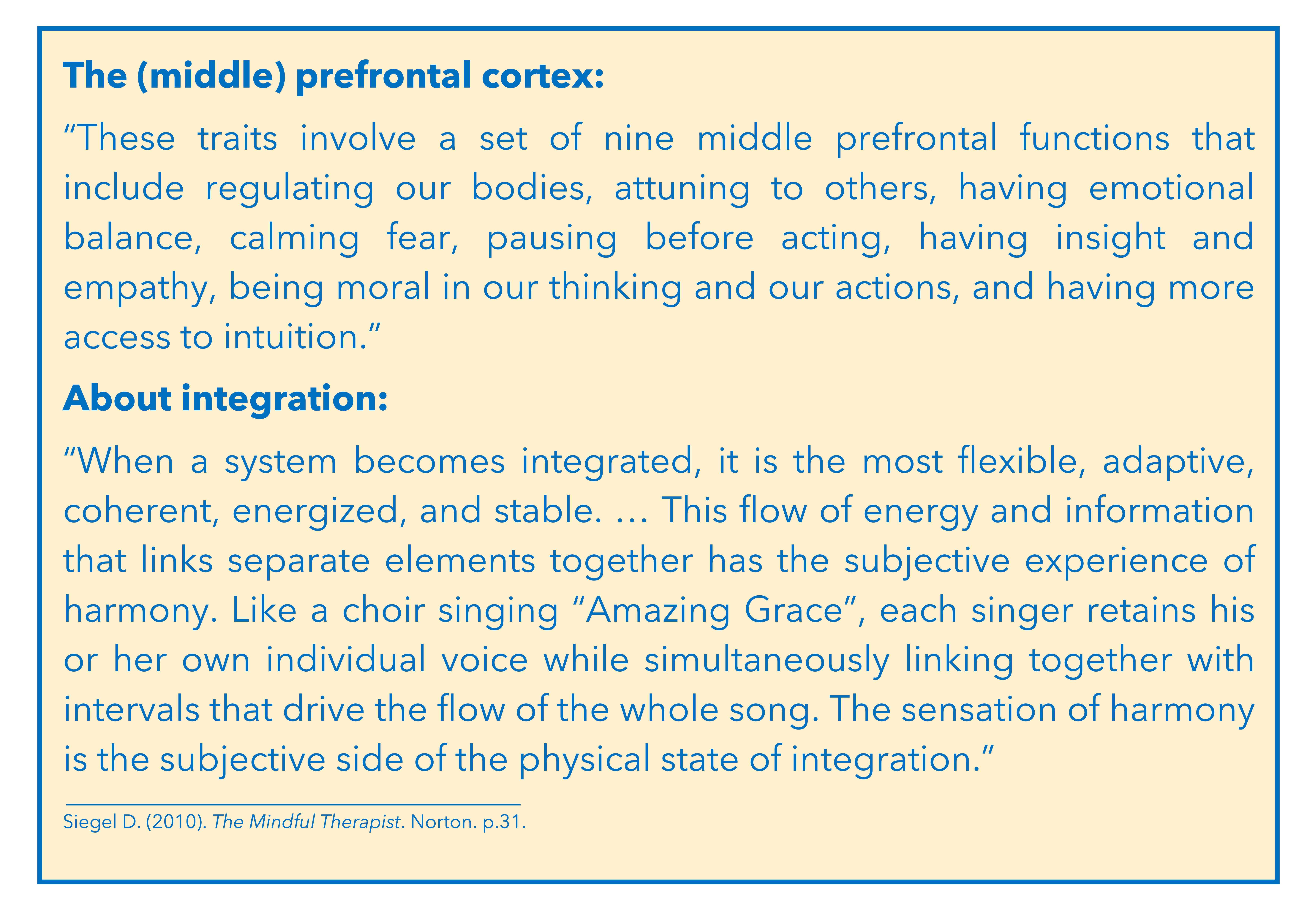
In therapy clients learn how to increase the connectivity between their reactive limbic system and their regulating prefrontal cortex. It’s the prefrontal cortex that makes us truly human. Without it we are just clever and very dangerous primates, which is self-evident. Our prefrontal cortex facilitates our empathy, self-awareness, moral and ethical thinking, it regulates our emotions, behaviour and our bodies and it is not driven by fear or survivalism.
The limbic system is supposed to function like our brain’s ‘safety officer’ — warning us of possible danger and threat, and of all the things that could go wrong. It’s evolved on a dangerous planet when life was precarious and survival was not guaranteed. A ‘safety officer’ is not equipped to be in charge. But in most people it is dominant and it’s not people’s fault. Without sufficient integration between these two systems, each time the limbic system experiences threat, it weakens and shuts down the prefrontal cortex. Improved integration gradually prevents this from happening, and all my clients experience this first hand.
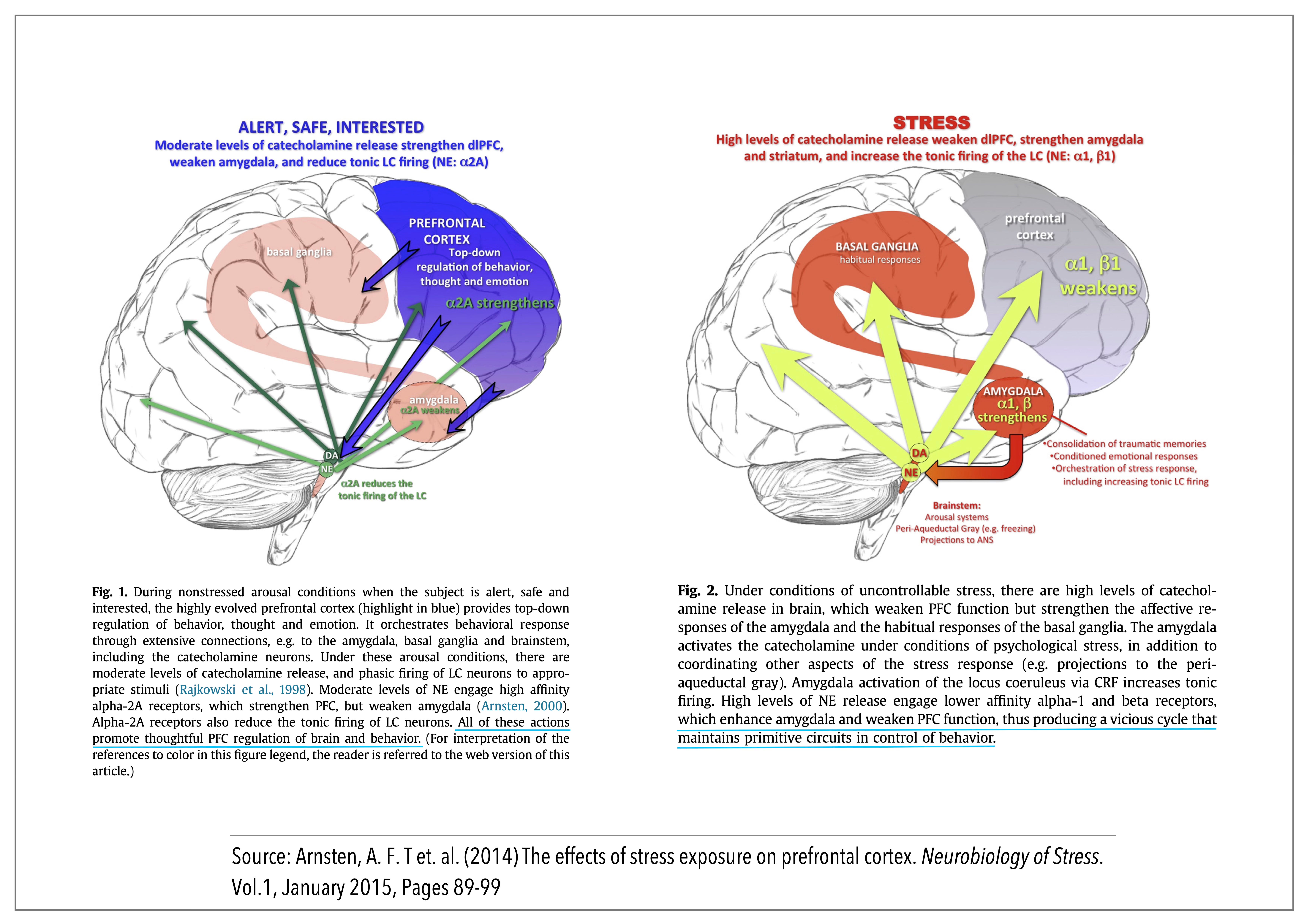
Real therapy isn’t analysis or telling stories to an empathetic therapist, hoping for the best. The framework I work with, Interpersonal Neurobiology (IPNB), makes therapy a practical process, not something abstract and incomprehensible. Therapy from this framework is not based on faith. It is evidence-based. Since adult brains cannot be changed from the outside in the same way as the brains of children, therapists are only facilitators. We cannot change our clients‘ brains directly, they have to do the work.
But what is the work? It is simpler than most people realise, albeit not necessarily easy. Clients learn to access their prefrontal cortex, notice the feelings (information) that their limbic brain generates and tries to communicate. By enabling an uninterrupted transfer of limbic information to the front of their brain, they increase the connections between these two brain systems. The transfer of information is enabled by validating all of our feelings — all of which are information from the limbic system telling us whether it thinks we are safe or under threat.
The human brain generates connections all the time. It’s how we learn. Practice and repetition reinforce those connections and lead to the creation of robust neural networks. It’s why ‘practice makes perfect’. The more validation people practise the quicker their brain changes.
What we think of as our psychology is regulated between those two brain systems, but they are not connected from birth. The connectivity exists in potential in the same way that our capacity to learn language exists in potential. Babies are not born with their mother tongue, they acquire it from the environment. Right from birth babies’ brains begin to wire in the language or languages spoken around them into the relevant brain areas. Everything that is around us from birth and throughout our development ends up wired inside our brain. Early in life we are wired from the outside in, but later we have to wire ourselves if we want to learn anything or develop psychologically.
Throughout human history parents have rarely provided the right input for their children to achieve the connectivity they need to be psychologically robust and well, ethical, empathetic, and to live life with ease and without psychological problems or inner warfare. Even people who have never suffered trauma present in therapy with crippling anxiety because of poor connectivity. You cannot live a full adult life, especially in a technologically advanced and complex world with the old threat and fear-based limbic brain in charge, and expect to be well psychologically. Most people come to therapy in a state of emotional and psychological dysregulation, which feels like overwhelm, feeling out of control, confused, fearful and in psychological crisis. This isn’t because they are sick but because their prefrontal cortex is not in charge and their limbic system is climbing the walls with fear.
Fortunately, we retain enormous neuroplasticity throughout life, which means we can change our brain’s architecture at any age. Of course it’s better if integration is supported by the environment early in life, but better late than never. Neuroplasticity, which makes us all life-long learners, is the same quality that enables us to also change our psychology at any age. Time doesn’t heal. Integration does. If time healed, I wouldn’t have a job because anyone with trauma would have healed simply with the passage of time. In addition to improved regulation, better integration between the prefrontal cortex and limbic systems also enables safe and efficient recovery from traumas and past hurts without re-traumatisation. Therapy done this way is inspiring and uplifting. It’s not draining, and it does not interfere with people’s daily functioning. My clients don’t dread their sessions. They look forward to them. Therapy from this framework is so much more efficient and doesn’t take as long as people imagine.
This is how therapy really works and why working from a coherent framework achieves such robust and reliable results. Psychotherapy is an inspiring and fulfilling profession. I get to witness change that my clients were hoping for but never believed was possible. I wouldn’t be able to write this, do my work or be the person I am if I haven’t been able to change the architecture of my brain and recover from my own traumatic past.
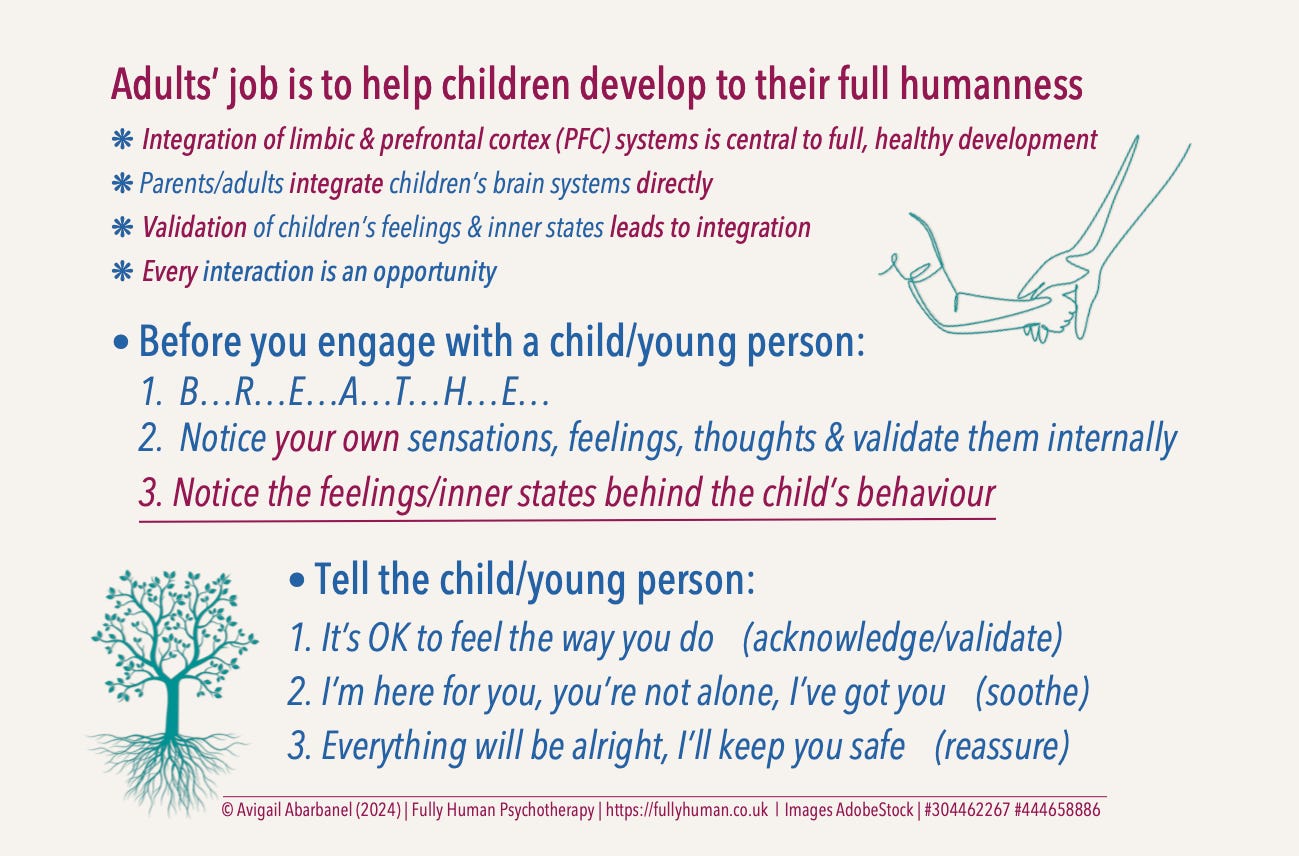
Sadly, I witness how badly and clumsily schools here treat children and young people. It’s as if no one knows or understands anything about human development. Children and young people are begging for validation, which is what they need from outside for their brains to integrate. But psychologists keep misleading parents and children by providing harmful approaches like CBT or worse, medication when all they need to develop well and be psychologically healthy is regular validation from the adults around them. Validation is free, but to provide it reliably adults need to be reasonably well-developed themselves and understand their role and what children and young people need from them. I can see generations of young people being harmed, or not supported to develop properly right now, and I can easily predict what will happen to them when they reach early adulthood. There are no surprises if you understand human development.
The question is no longer whether therapy works at the individual level — done properly, we know it does. The question is what would it mean to apply this understanding at scale? We invest enormous resources in managing the symptoms of poor development — the mental health system, the criminal justice system, the political systems designed to contain rather than develop human beings — and almost nothing in the developmental work that would make those systems less necessary.
The people who will navigate what’s coming with the most integrity — who can remain witnesses, grow through rather than merely survive, think clearly from a regulated nervous system in the midst of genuine civilisational crisis — don’t need to be rare exceptions. The process to achieve this is teachable and replicable. That is what therapy, properly understood, actually offers.
This is not a utopian argument. I am not suggesting that better therapy will stop bombs falling on Iran right now, or reverse the AMOC. What I am saying is that the quality of what comes next — whether humanity moves through this period of unravelling with increasing capacity, or regresses toward the world the cautionary tales have been warning us about — will be determined by the neurological development of enough individual human beings to tip the balance.
Outside my window in the Scottish Highlands, Storm Dave is bringing heavy snow in the first week of April. The seasons are shifting. The world is not what it was.
A comment on paid subscriptions
Substack encourages writers to activate paid subscriptions. They take a small cut to enable them to provide this, otherwise free-to-use platform. I am grateful to the readers who have pledged money for monthly or yearly subscriptions, but I have no intention of monetising my work.
I do not want to turn my writing into an obligation, but even more importantly, I don’t believe in a tiered system where those who can pay get preferential treatment over those who can’t, such as the right to comment, or privileged content. This hierarchy of ‘worthiness’, especially based on such an arbitrary principle like how much money people have, couldn’t be further from my values.
As a self-employed person I could really use the pledges and donations. So if you do feel moved to make a contribution to support my writing, please use the ‘buy me a coffee’ button below. Payments are processed securely by Stripe on the ‘Buy Me A Coffee’ site. People can keep donations anonymous if they wish.
This is entirely voluntary. Everyone is, and always will be welcome to read my work free of charge.
Thank you so much for reading my work!
This war was started with lies, by Israel and America, and they never stopped lying. Israel and America should be made pay for this war, including reparations to Iran.
Thanks for your today's post !!! 👍👍👍
Isn't the current dire human condition you so well described fully intentional and by design ??? ... 🤔🤔🤔
Even obesity-rates are no coincidence ...